Shoppers already worry about food safety. What they lack is proof they can check. This plan builds that proof and turns it into an ownable category.
Grounded in the Project Mindset study (n=305, 5 metros, fielded by 1Lattice), FSSAI data and 2026 India media costs. Every figure is sourced.
The market splits between cheap conventional staples and expensive organic. The affordable, provably-safe middle sits open. The evidence follows.
Consumers move from worry to premium action through five stages. The drop-off is about proof they can act on, not desire. The last stage, premium spend, is where the category is won or lost.
Share of consumers giving a label full trust (5/5), before and after an independent lab certificate is added. "Pesticide-free" gains the most, a 5x jump, because the bare claim is trusted least.
Factor analysis (KMO 0.89) and k-means clustering of 305 shoppers produced four groups. They differ in how they decide who to trust. Each needs different proof, in a different order.
"The word organic on a label means nothing to me anymore. Show me the actual test report for this batch and I'll happily pay more."
"If my doctor and my sister both say it's good for the family, that's all the proof I need. I'm not going to scan codes."
"I just buy whatever brand I know that looks decent and isn't overpriced. Food safety isn't something I lose sleep over."
"Every brand says it's pure. Prove me wrong, but don't insult me with marketing."
Guardians are the largest segment, the highest payers, and the only ones who respond to the asset Honest Farms already has. Their reviews and doctor conversations become the trust signal that activates the Believers, and doctor/dietitian endorsement is the single bridge that serves both. Together they are 56% of the market.
A realistic day for each archetype, built from the study's channel and media data. The green moments are where Honest Farms can show up, and what to say when it does.
Each channel is rated for its fit against each archetype, with the job it does. Spend follows fit, not habit.
| Touchpoint | Verifier 36% | Believer 20% | Cruise-Ctrl 26% | Sceptic 18% | Primary job |
|---|---|---|---|---|---|
| Retail media / quick-commerce, the #1 reach & conversion layer | |||||
| Blinkit / Zepto / Instamart, sponsored + PDP | High | Low | High | Low | Win the shelf + host the QR proof at point of decision |
| BigBasket, considered-purchase, cert detail | High | Med | Med | Med | Where QR & certification content converts best |
| Amazon / Flipkart / JioMart PDP | High | Low | Med | Med | Rich evidence PDP + reviews trail |
| Kirana (41% still shop here) | Low | High | Med | Low | Reinforce a trusted recommendation in person |
| Digital & social | |||||
| Instagram / Meta (interest-targeted) | High | Med | Med | Low | Evidence reels to Verifiers; retargeting for proof |
| YouTube / CTV (audience-targeted) | Med | High | High | Low | Warm storytelling + taste/value; SEC A/B precision |
| Health / nutrition / parenting influencers | High | High | Med | Low | Micro-creators carry a trust premium (66% vs 28%) |
| WhatsApp (opt-in CRM) | High | High | Med | Low | Retention, reorder, recipe tips, not cold reach |
| People-led: doctors, dietitians, communities | |||||
| Doctor / paediatrician & dietitian endorsement | High | High | Low | Med | The bridge that serves Verifier & Believer at once |
| RWA / MyGate (5M+ premium homes) + sampling | Med | High | Med | Low | Hyperlocal premium-household reach + trial |
| Parenting communities (Momspresso, BabyChakra) | Med | High | Low | Low | Warm WOM seeding among mothers |
| Physical / OOH / broadcast | |||||
| OOH, metro, premium-corridor hoardings, DOOH | Med | Med | High | Low | Category salience & default-brand fame in metros |
| Linear TV (thin premium GEC overlay) | Low | High | Med | Low | Reach the 45+ matriarch; brand-equity halo |
| Earned PR / investigative & farmer-direct content | Med | Low | Low | High | The only channel that reaches the Sceptic |
The premium depends on proof, and the segments convert in sequence. Verifiers create the evidence. That evidence becomes the social proof that converts Believers. Together they make "pesticide-free" familiar enough that Defaulters adopt it on the shelf.
The first rupees make proof impossible to miss for the Verifier. Her verified purchase is the cheapest, most credible media the brand can run. Every review she writes and every doctor she talks to is earned reach into the next segment. That is why the plan funds proof before paid reach.
A directional allocation for the launch phase, deliberately concentrated on quick-commerce (reach + the QR proof moment) and people-led credibility (doctors, dietitians, micro-creators), with a lean OOH/CTV layer for category fame. Percentages are planning guidance, to be calibrated against live CAC.
Platform rate cards are rarely public; figures below are cited agency/industry benchmarks and should be treated as indicative and negotiable.
| Channel / format | Indicative cost | Role for this brand |
|---|---|---|
| Blinkit, Product Booster (sponsored) | CPC ₹2–15 · banner min ₹2.5L | Own the shelf + reorder moment (self-serve, inventory-gated) |
| Zepto, bundled brand pack | ₹5–6 L + Atom analytics ₹30k/mo | Second q-comm reach layer |
| BigBasket, banner / video / roadblock | ~₹89–127 CPM · roadblock ₹1.9L/day | Considered purchase + certification detail |
| Meta (Instagram/FB), premium female target | CPM ₹80–90 · CPC ₹10–20 | Evidence reels + retargeting for Verifiers |
| YouTube / CTV, audience-targeted (PMP) | CPV ₹1.5–2.5 · CTV CPM ₹350–700 | Warm story + taste/value; SEC A/B precision |
| Influencer, food/health micro (10–100k) | ₹15,000–35,000 / reel | Best relevance-to-cost; +60–120% for whitelisting |
| MyGate, premium-household ad + sampling | Door-hanger ₹18/sample · custom | 5M+ NCCS A/A+ homes; trial & Believer reach |
| OOH, premium metro hoarding (30×20) | ₹0.6–4.5 L / month (landmark 3–5×) | Category fame in tech/premium corridors |
| Metro branding, Mumbai train (interior) | ₹21,500 / train / day | Captive metro commuter salience |
| WhatsApp Business, marketing template | ₹0.88 / message (opt-in) | Retention, reorder, recipe tips |
An illustrative scenario for a brand at Honest Farms' scale (about ₹50–60 Cr, targeting ₹300 Cr in three years), roughly 10–12% of revenue into working media. Treat it as a planning model to calibrate against live CAC, not a committed budget.
| Channel | Share | Year-1 ₹ |
|---|---|---|
| Quick-commerce & retail media | 34% | ₹2.21 Cr |
| Proof infrastructure (QR, lab, traceability) | 14% | ₹0.91 Cr |
| Doctors, dietitians & HCP | 12% | ₹0.78 Cr |
| Influencers (health/nutrition/parenting) | 12% | ₹0.78 Cr |
| Meta + YouTube/CTV | 12% | ₹0.78 Cr |
| RWA / MyGate + sampling | 8% | ₹0.52 Cr |
| OOH / DOOH | 5% | ₹0.33 Cr |
| Earned PR / farmer-direct | 3% | ₹0.19 Cr |
| Total working media | 100% | ₹6.50 Cr |
A directional funnel to pressure-test the plan, every step is a labelled assumption, not a forecast. It exists to show the shape of the economics and where the sensitivities sit.
| Step | Assumption (labelled) | Working | Result |
|---|---|---|---|
| Working-media budget | ~11% of revenue for a scaling premium D2C brand (industry range 8–15%) | 0.11 × ₹55 Cr | ≈ ₹6.5 Cr |
| First-time triers | Blended cost per first trial ₹140 (q-commerce new-buyer CAC ~₹100–200; sampling ~₹15–30 at low conversion) | ₹6.5 Cr ÷ ₹140 | ≈ 4.6 L |
| Repeat buyers | 40% trial-to-repeat (proof + reorder mechanics lift it above a typical 25–30%) | 4.6 L × 0.40 | ≈ 1.85 L |
| Annual value / buyer | ~₹1,800 (about ₹150/month of dal, rice and atta across the year) | 1.85 L × ₹1,800 | ≈ ₹33 Cr |
| Run-rate range (repeat 30–45%, value ₹1,600–2,000) | ₹28–40 Cr | ||
Brand or product is a false choice. Build one proof system that every SKU carries, then launch product-first where worry and willingness-to-pay run highest. The brand earns permission; the product closes the sale.
A single, consistent trust platform that never changes: every pack, verifiable proof. It carries the warmth of an Indian kitchen and the rigour of a lab report at once, "Honestly Safe, Honestly Better." This is what makes the Believer feel safe and the Sceptic pause. It is a decade-long, repeat-until-it-compounds message, in the tradition of "Desh ka Namak."
Launch messaging fires product-first where the study says the money is: Tur Dal (highest worry + medically-driven switching, the sweet spot), then Makhana ("you were right to trust it, here's the proof"), Rice for volume, and Khapli atta as a health-forward halo. Each product carries the same proof, tuned to its own trigger.
Ordered from the backbone claim to the product proof points. Pillars 1–2 are brand-level and never change; 3–5 flex by product and by ICP.
Batch-level, QR-accessible lab reports. "Below detectable limits," not "200 chemicals tested." The proof is exactly as strong as the published test, and no stronger. This is the backbone the Verifier demands and the category is built on.
The smarter everyday health choice, never an unattainable promise of perfection, and never fear-mongering about rivals (which the law and the Verifier both punish). Honest about what the test does and doesn't say.
Traceability to the source cluster, sourced from ~5,000 farmers in the DeHaat network who earn a 30–50% margin. The human, farmer-direct voice that earns the Sceptic and warms the Believer.
Provably safe, everyday-affordable, ~10–15% above conventional, ~10–20% below organic. Positioned squarely in the daily basket, not the occasional splurge. This is how the Cruise-Controller justifies the switch.
Unpolished dals with nutrients intact; low-GI Khapli atta; GI-tagged Mithila makhana. Product-specific health truth, tuned to the health-first lens through which 46% of these shoppers filter every decision.
Honest Farms already spans rice, unpolished dals, millets, whole & ground spices, makhana, ghee, honey and flours. The launch order is set by the study's Trust Tension Map, not by inventory.
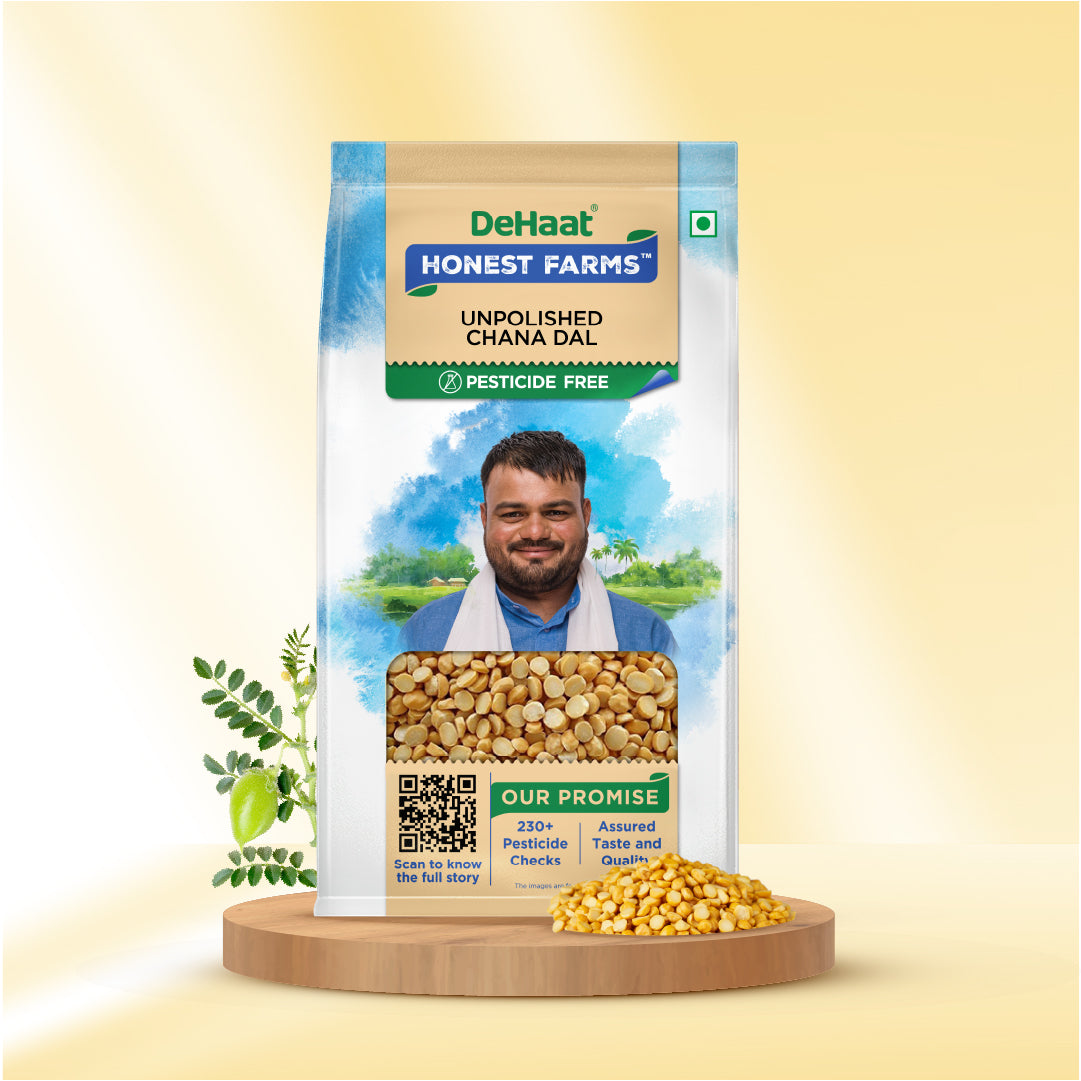
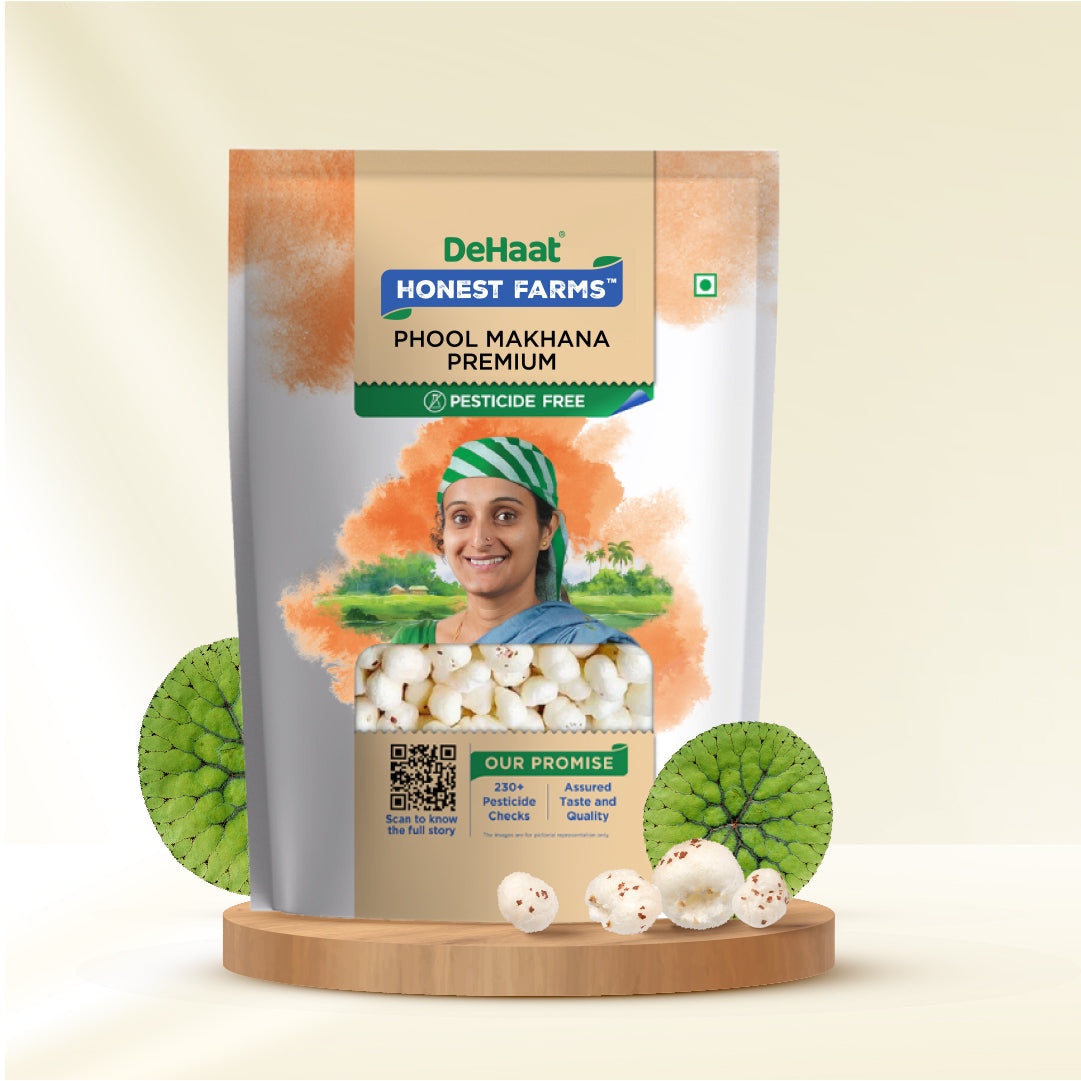
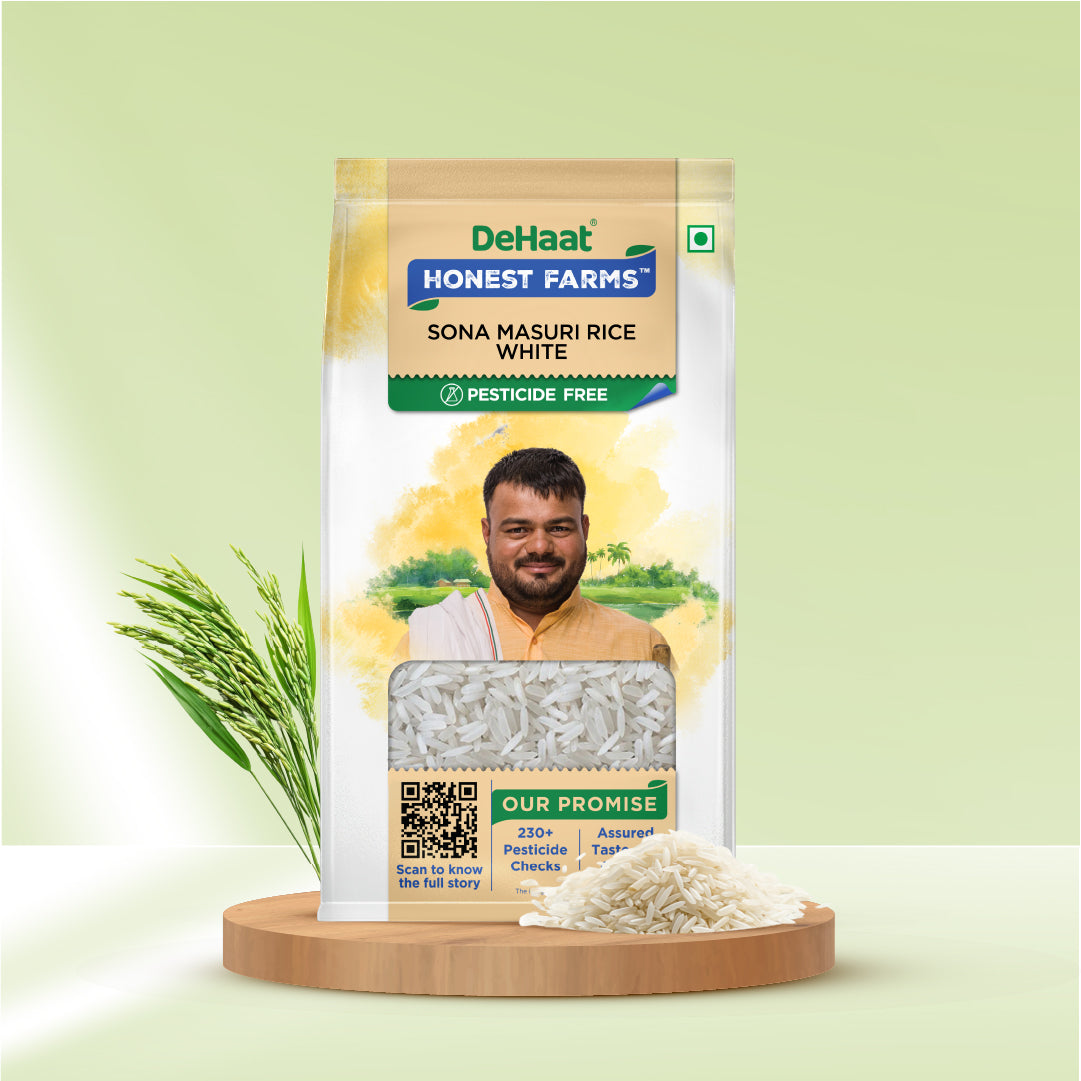
Khapli (emmer, Triticum dicoccum) is an ancient wheat with a low glycaemic index (~40–45 vs ~70 for modern wheat) and higher fibre, a direction supported by clinical evidence, and riding the Year-of-Millets / ancient-grains tailwind. It is Honest Farms' only wheat flour, which makes it a deliberate health statement rather than a commodity atta. Priced mid-market (~₹210–220/kg), it sits between Two Brothers' premium and Aashirvaad's mass value anchor.
"Organic" is legally reserved, costly to certify, and already held by giants (24 Mantra at mass, Organic India at wellness, both now inside ITC and Tata). "Pesticide-free," defined and proven, names the affordable, provably-safe middle no large packaged brand has claimed.
In fresh produce, "residue-free" is used only by small players, several of which failed to scale. In packaged staples, it is a clear, defensible whitespace. But it is a prove-it claim, not a trust-us claim.
Pesticide-Free as a verified-outcome standardnot a farming method: sourced under controlled low-input protocols and lab-verified batch-by-batch to contain no residue above the lab's Limit of Quantification, across a 230+ pesticide panel.
| Possible basis | Verdict |
|---|---|
| "Zero pesticide, ever" | Reject Unprovable, legally exposed |
| "Within safe MRL limits" | Reject Conventional can claim it too |
| "No detectable residue (below LOQ)" | Adopt Provable, batch-level, above conventional |
Legally, this is the defensible lane: "pesticide-free / residue-free" is undefined in FSSAI law but permitted if truthful and substantiated below LOQ (~0.01 mg/kg), and must never imply rivals are unsafe (Reg 10(5)).
The site promises "Pesticide Free" and "230+ quality checks." But the Pesticide-Free Certificate page renders effectively blank, no lab, no NABL reference, no residue limits, no batch report.
42% want a plain-language explanation of how it was grown & tested. 16% want a QR to the actual batch lab report. The Verifier will scan, and if it's empty, she leaves.
Turn the blank certificate into a batch-level, QR-accessible, NABL-verified residue report. This is Country Delight's DRDO test-kit and Eggoz's "11 checks", proof placed in the customer's hands.
Every durable trust-claim brand in Indian food followed the same handful of moves. The pattern is remarkably consistent.
Put the test in the customer's hands, don't just assert it.
Country Delight (DRDO milk-test kit, ₹1,380 Cr) · Eggoz ("11 checks", ₹130 Cr)
A concrete negative makes the claim sticky and instantly parsed.
Slurrp Farm ("no maida, no refined sugar") · Saffola (cholesterol)
First to name the category holds a durable moat.
Tata Salt (branded iodised salt, 1983, still leads)
Design proof into operations, don't bolt it onto ads.
Amul (co-op = self-policing) · Country Delight (cold chain)
Category ownership is a decade-long, consistency game.
Amul Girl (39 yrs) · "Desh ka Namak" (since 2002)
A claim only pays off where it's easy to act on.
Eggoz (#1 on q-commerce) · Intel Inside (subsidised the channel)
83% already worry, so the brand need not teach people to care. The job is to convert that worry into a verified purchase, and each purchase into advocacy that lowers the cost of the next. The funnel below shows the media job at every stage.
Category education that "pesticide-free" is more specific and verifiable than organic (32% already sense this). Q-commerce shelf presence + premium-corridor OOH + CTV build salience.
The certificate dividend in action, QR batch reports on the PDP and pack, doctor/dietitian endorsement, evidence reels. This is the stage everyone else skips and where the sale is really made.
Small-pack trial (33% "try a small pack first"), RWA/MyGate sampling, and a minimal, easily-justified premium in the sweet-spot category (Tur Dal). Trial is where the accessible-middle price does its work.
Become the default on Blinkit/Zepto, ratings, bestseller tags, presence at reorder. WhatsApp reorder + recipe nudges keep the habit. This is how the Cruise-Controller is captured without a single fear message.
Reviews, referral, doctor conversations and community WOM. The Verifier's verification becomes the Believer's social proof, the loop turns, and the cost of the next cohort drops.
Win the beachhead with proof, turn advocacy into social proof, then carry the 56% into default leadership, extending the proof system product by product.
Consumer figures come from the Project Mindset study (proprietary). Market, media, competitor and legal figures come from the public sources below. Rate-card numbers are indicative and negotiable; modelled figures are labelled as guesstimates with their assumptions shown.
